A proposal in a dormitory window
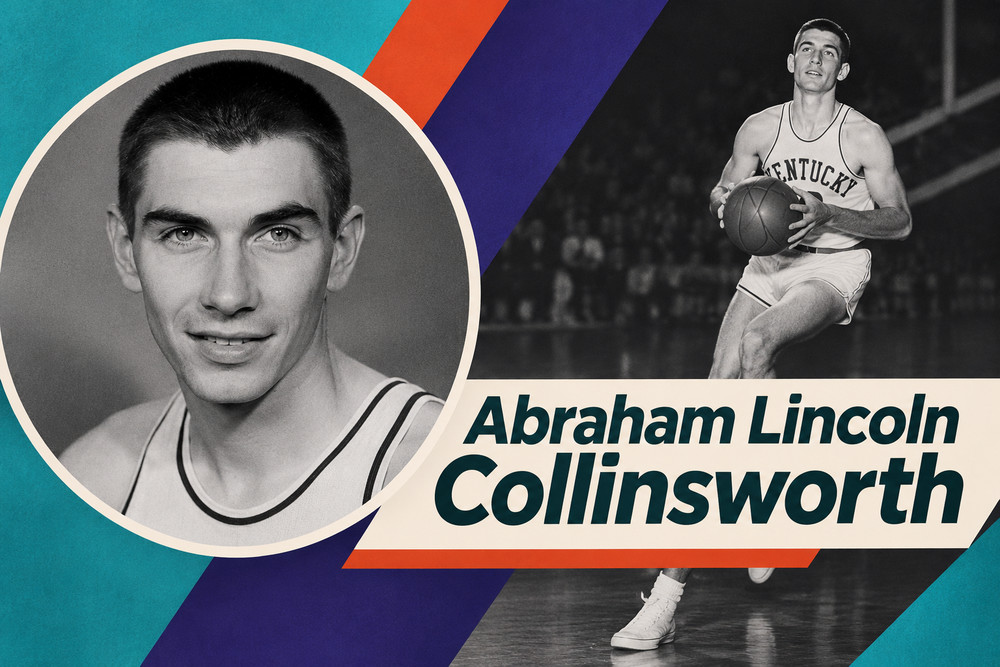
A sign in a dormitory window carried Abraham Lincoln Collinsworth’s marriage proposal to Donetta Browning. They had met at the University of Kentucky, where he played basketball and she was a student from Logan, West Virginia. The message asked her to marry him; in 1958, they did. That small, physical detail gives me a useful starting point for a marriage that would take them from Kentucky to Ohio classrooms and then to Florida public schools.
Both became educators. Their early married years included teaching and coaching in the Kings Mills area of Ohio, where Abe also played semi-professional basketball. Two sons arrived during those years: Anthony Cris Collinsworth, born in Dayton on January 27, 1959, and Gregory Paul Collinsworth, born in Ohio on September 27, 1960. A college courtship had become a household with two young children and two parents working in education.
February 12 and three historical names
Long before the proposal, a birthday had supplied his full name. Born on February 12, 1936, Abraham Lincoln Collinsworth shared President Lincoln’s birthday. He grew up in Salyersville, in Kentucky’s Magoffin County, one of seven children of county judge Green Wade Collinsworth and Kitty Collinsworth. The presidential connection was the date, rather than an established family relationship.
His brothers William McKinley Collinsworth and Alexander Hamilton Collinsworth were likewise named for historical figures whose birthdays matched their own. At Salyersville High School, Abraham was known as Lincoln. He became a distinguished basketball scorer there, before the University of Kentucky brought both stronger competition and a shorter name: coach Adolph Rupp called him Abe. It stuck.
A reserve guard on the Fiddlin’ Five roster
Kentucky’s 1958 national championship gave Collinsworth a place on the team remembered as the Fiddlin’ Five. A guard during his college years in the 1950s, he served as a reserve, backing up players including Vernon Hatton and Adrian Smith. The championship was an achievement he shared with the roster; his role was not that of a starting star.
That distinction sharpens my understanding of his basketball career. A high-school scorer became a college reserve, then continued playing while earning his living as an educator. Competition did not end with his university years. After semi-professional basketball in Ohio came AAU basketball in Florida, where he also coached high-school students. Playing and teaching occupied the same stretch of his working life.
The benching at Eau Gallie
In 1963, Abe and Donetta moved their sons to Brevard County, Florida. Both parents took teaching jobs in the Melbourne and Eau Gallie area, and Abe became head basketball coach at Eau Gallie High School. Three years later, a holiday tournament put a decision about one player into a much larger setting.
The 1966 tournament included Black high schools as integration began. When an Eau Gallie star shoved an opposing player, Collinsworth benched his own player. Eau Gallie lost to Monroe, 83 to 50. The score was emphatic, but keeping integrated competition possible took precedence over protecting the chance of a win.
Discipline also demanded work away from the court. During his administrative career, Collinsworth explained disciplinary decisions in both Black and white churches. These responsibilities required him to address the communities affected by school decisions as well as the students involved. Coaching was only one part of his work in education.
| Topic | Detail |
|---|---|
| February 12 and three historical names | Born on February 12, 1936, Abraham Lincoln Collinsworth shared President Lincoln’s birthday. |
| The benching at Eau Gallie | In 1963, Abe and Donetta moved their sons to Brevard County, Florida. |
| Opening Astronaut High School | After serving as an assistant principal at Cocoa High School, Collinsworth opened Astronaut High School in Titusville as its first principal in the early 1970s. |
Opening Astronaut High School
Teaching, coaching and counseling led to school administration. After serving as an assistant principal at Cocoa High School, Collinsworth opened Astronaut High School in Titusville as its first principal in the early 1970s. Both Cris and Greg attended while their father held that position. School authority and parenthood met in the same building.
At home, Donetta strongly advocated for her sons with their coaches. Their father’s coaching work also meant that Cris spent long stretches of summer at basketball camp. Athletics filled substantial parts of the boys’ childhood, alongside their parents’ careers in public education. In 1977, Abe became assistant superintendent for personnel, moving from responsibility for an individual school to work across the district.
Brevard leadership and an unresolved departure
Collinsworth became Brevard County superintendent in 1989. His early work included improving labor relations, establishing a magnet program at Ronald McNair Middle School for gifted students and technology, and beginning an experiment with year-round schooling. Communication earned him praise. Facilities, maintenance and decisiveness drew criticism.
Disputes over school-board involvement in administrative recommendations helped prompt an accreditation investigation. By 1992, whether to renew his contract had become a public dividing line among board members, while the district faced possible accreditation probation. His superintendent years therefore included both new educational programs and serious institutional conflict.
The circumstances of his departure remain unresolved, particularly the relationship between his removal as superintendent and his retirement in 1994. I give that uncertainty room here because the distinction affects how his final working years are understood. The initiatives and criticism belong in the account together.
Two sons and a Sunday night tribute
Cris became a Cincinnati Bengals receiver and later a prominent football broadcaster. Greg played basketball at Florida State University before entering financial planning. On October 29, 2004, Greg died of colon cancer at 44. Abe and Donetta had lost their younger son.
Retirement included golf and time with family. Around his seventy-fifth birthday, Abe played golf with Cris and nearly shot his age. He died in Orlando on October 13, 2012, at 76. The following night, Cris called his father his hero during Sunday Night Football. Abe was buried at Doctor Phillips Cemetery in Orlando, where Greg was also buried. Donetta died in 2023.
FAQ
How did Lincoln become known as Abe?
Lincoln was the name he used at Salyersville High School. At the University of Kentucky, coach Adolph Rupp began calling him Abe, and the nickname remained with him.
What was his role on Kentucky’s 1958 championship team?
He was a reserve guard on Rupp’s NCAA championship roster, backing up players including Vernon Hatton and Adrian Smith.
Which members of Cris Collinsworth’s household were his grandchildren?
Cris and his wife, Holly, have four children: Katie, Austin, Ashley and Jac. They are Abe and Donetta’s grandchildren. Cris and Greg were the couple’s two sons.