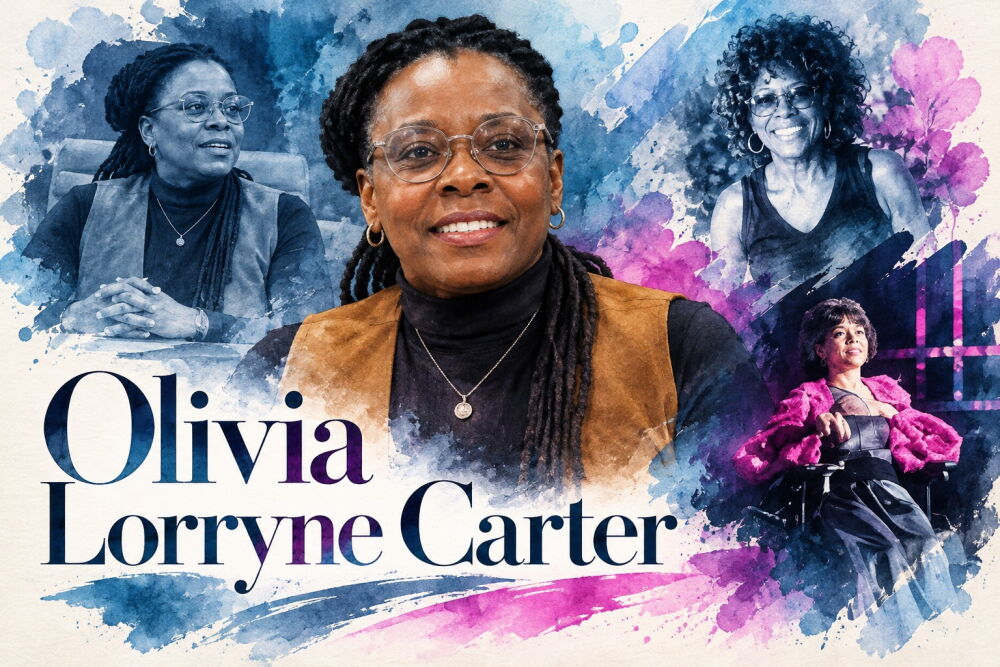
Olivia Lorryne Carter enters the story of Rage Against the Machine through a quieter doorway than a concert stage. Her son, Zack de la Rocha, became a voice recognized for its anger, precision, and political force. Her own documented work concerns anthropology, graduate research, and the arithmetic people use in everyday life. I find that distinction essential. She belongs to a famous family story, but her university years also give her a history beyond motherhood.
The clearest dates place her at the University of California, Irvine, between 1983 and 1987. Those years overlapped with Zack’s adolescence. A dissertation, a household, and a teenager’s changing understanding of the world occupied the same period. It is an unusually revealing intersection, even though much of Olivia’s private life remains outside public view.
Understanding Her Name and Background
Olivia appears under several versions of her name. Olivia Lorryne Carter is the name frequently used in accounts of Zack’s early life. Olivia de la Rocha and Olivia Lorryne De La Rocha appear in connection with her academic work. These variations help explain why a search for one spelling can produce a different-looking identity.
I would not turn those variations into a story about when or why she changed her name. The available details establish the spellings, not a complete personal chronology. Carter and De La Rocha belong in the same discussion, but the dates of particular naming choices remain unclear.
Her birth date is similarly uncertain. A birth year around 1941 circulates, yet it is not firmly established. A precise age therefore adds confidence the record does not support. Her ancestry has also been described inconsistently. Rather than assign a neat ethnic label, I prefer to leave that part of her background open.
A Family Connected to Art and Music
Olivia’s son, Zacharias de la Rocha, was born on January 12, 1970, in Long Beach, California. Known professionally as Zack de la Rocha, he became the vocalist of Rage Against the Machine. His father, Robert “Beto” de la Rocha, is a Chicano artist associated with the collective Los Four.
That family connection places visual art and music on either side of Zack’s upbringing. Beto’s work belongs to a particular artistic and cultural history. Olivia’s anthropology studies brought another kind of intellectual work into the household. I see a family with several distinct creative and scholarly paths, rather than a single explanation for how one musician developed.
Olivia and Beto separated, but the timing is disputed. Some accounts place Zack at approximately one year old, while others say six. Their marriage had ended before his adolescence. It would be misleading to choose one childhood age simply because it makes the narrative easier to tell.
Zack spent important years living with his mother in Irvine and also had contact with his father. Beto later experienced a serious personal crisis that affected his painting and family relationships. Those events are part of the family history, but they do not reveal every private conversation or feeling within it.
The Irvine Years and Doctoral Research
Olivia’s academic record has more definite boundaries than many details of her early biography. She was a doctoral student in UC Irvine’s School of Social Sciences from 1983 to 1987. She also worked as a graduate student researcher at the university’s Institute of Transportation Studies during 1983 and 1984.
Her dissertation, dated January 1987, was titled Problems of Sense and Problems of Scale An Ethnographic Study of Arithmetic in Everyday Life. The work is associated with the name Olivia Lorryne De La Rocha. Anthropology is the field connected with her doctoral studies.
The subject catches my attention because everyday arithmetic sounds familiar until we consider how many decisions depend on it. People estimate, compare, calculate, and adjust within the routines of ordinary life. Her dissertation title points toward an ethnographic interest in those practices. It does not, by itself, tell us her findings, and I would not supply an argument she may never have made.
A June 1984 transit evaluation manual is also associated with her university research record. That connection supports an account of graduate research activity. It does not establish that she alone wrote the report or went on to a specific transportation career.
Dates That Clarify Her Story
| Date or period | Established connection |
|---|---|
| January 12, 1970 | Birth of her son Zack in Long Beach |
| Before Zack’s adolescence | Her marriage to Beto had ended |
| 1983 to 1987 | Doctoral study at UC Irvine |
| 1983 to 1984 | Graduate research at ITS Irvine |
| June 1984 | Associated transit evaluation report |
| January 1987 | Dissertation date |
| 1999 | Public discussion of her dissertation years |
These dates form a small but sturdy framework. I find them more useful than a crowded biography built from assumptions. They show the overlap of parenting and postgraduate work while leaving uncertain details where they belong.
A Public Connection Without a Public Career
Olivia is discussed primarily because of her son, but visibility through a relative is different from a public occupation. Her documented doctoral work does not establish later employment as a professor, therapist, social worker, or professional activist. None of those titles should be attached to her without firmer information.
The same restraint applies to money and relationships. There is no dependable personal financial picture to present, and no established account of another spouse or additional children. I read these limits as part of an accurate portrait. A person can matter deeply within a family without leaving a complete public record.
FAQ
Who is Olivia Lorryne Carter?
She is Zack de la Rocha’s mother and a UC Irvine doctoral graduate whose academic work appears under Olivia Lorryne De La Rocha.
What did she study?
Her doctoral field was anthropology. Her January 1987 dissertation examined arithmetic in everyday life through an ethnographic approach.
Who is Zack de la Rocha’s father?
His father is Robert “Beto” de la Rocha, a Chicano artist and member of Los Four. Olivia and Beto’s marriage ended during Zack’s childhood.
Is Olivia’s birth year confirmed?
No precise birth year is firmly established here. The often repeated year of approximately 1941 should be treated as uncertain.